
OCI Cloud Security: 5 Fundamentals Developers Should Get Right
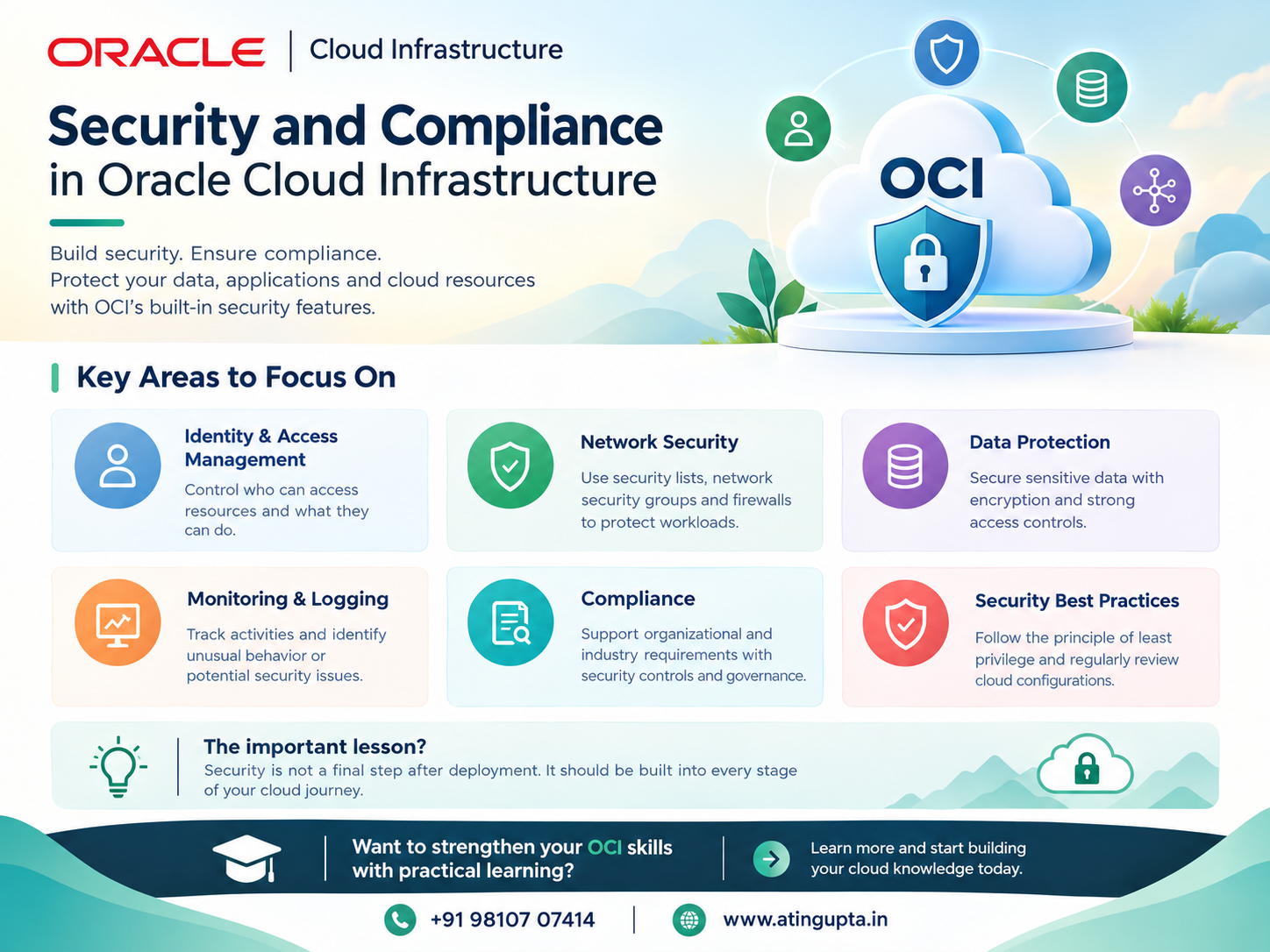
Cloud security is not something to fix after deployment. It should be part of the architecture from the start.
When building applications on Oracle Cloud Infrastructure (OCI), security and compliance can become complex quickly if the fundamentals are overlooked.
For developers and cloud engineers, focusing on a few core security practices can provide a strong foundation for building safer cloud applications.1. Identity and Access Management
Start by controlling who can access cloud resources.
Use least-privilege permissions so users and services receive only the access they actually need. Well-defined identity policies can reduce unnecessary access and limit the potential impact of compromised accounts or services.
Access should also be reviewed regularly as teams, applications, and responsibilities change.
2. Network Security
Not every workload needs to be publicly accessible.
Use appropriate network segmentation and security controls to limit unnecessary exposure. Applications and services should be placed within network boundaries that match their requirements rather than exposing resources by default.
A simple principle is useful here:
If a resource does not need public access, do not expose it unnecessarily.
3. Data Protection
Sensitive information needs protection both at rest and in transit.
Encryption, access controls, and appropriate data-handling practices should be considered during the architecture and development stages rather than added later.
Developers should understand what data an application handles, where that data is stored, who can access it, and how it moves between services.
4. Logging and Monitoring
You need visibility into what is happening inside your cloud environment.
Logging and monitoring can help identify unusual activity, troubleshoot application issues, and support security investigations.
Without useful visibility, it becomes much harder to understand whether an unexpected event is an application problem, a configuration issue, or a potential security incident.
5. Governance and Compliance
Security is also about following organisational and regulatory requirements.
Clear policies and governance controls can help keep cloud resources aligned with those requirements as the environment grows.
Governance becomes particularly important when multiple teams, applications, and cloud resources are being managed across the same environment.
A Practical Approach to OCI Security
You do not need to make a cloud architecture unnecessarily complicated just to make it secure.
Start with the fundamentals:
Strong identity controls → Limited network exposure → Protected data → Useful logging → Regular access reviews
As the environment grows, continue reviewing these controls rather than treating security as a one-time task.
Security should evolve alongside the application.
Why These Fundamentals Matter
For developers and cloud engineers learning OCI, these practices provide a solid foundation for building safer cloud applications.
Understanding security at the architecture level also makes it easier to make better decisions about identity, networking, data, monitoring, and governance.
The most effective approach is to build security into the application and infrastructure from the beginning, rather than trying to add it after deployment.
What About Your Cloud Deployments?
Which security practice do you consider most important when deploying applications to the cloud?
Identity and access management, network security, data protection, logging and monitoring, or governance and compliance?
Share your perspective in the comments.


