Building AI on a Strong Data Foundation
Building AI without a strong data foundation can create more problems than it solves.
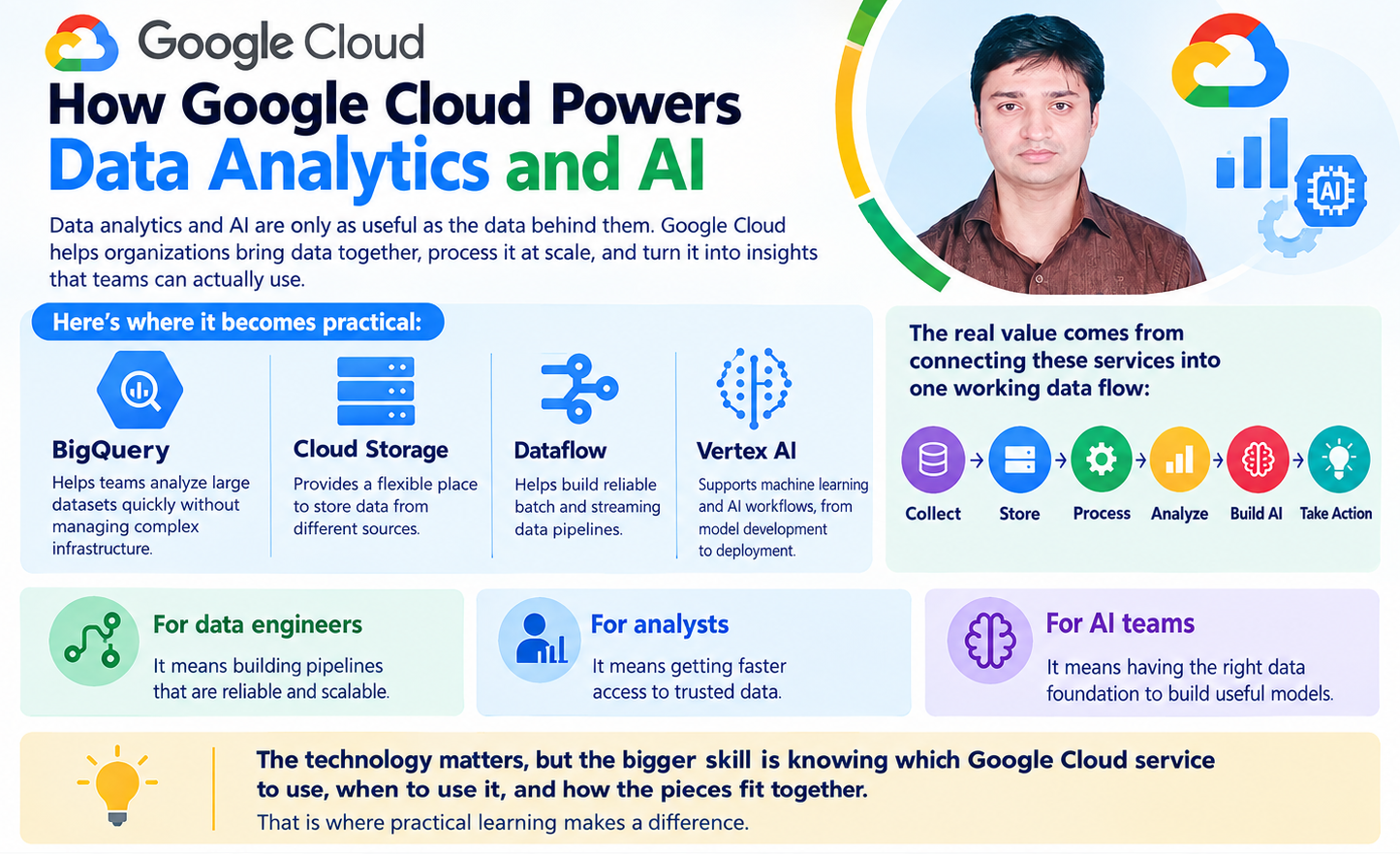
Google Cloud provides a practical path from raw data to analytics and AI. The important part is understanding how the services fit together, rather than trying to learn every service separately.
A simple architecture can look like this:
Data → Processing → Analytics → AI → Insights
Here's where Google Cloud services can fit:
Cloud Storage — Store structured and unstructured data.
Dataflow — Process batch and streaming data.
BigQuery — Run large-scale analytics using SQL.
Looker — Turn data into dashboards and business insights.
Vertex AI — Build, test, and deploy AI solutions.
For example, imagine an application collecting customer activity data.
The data can be stored in Cloud Storage, processed through Dataflow, analyzed in BigQuery, and then used with AI to identify patterns or generate useful predictions.
The key lesson is simple
AI works better when the data pipeline behind it is well designed.
You also don't need to build a complicated architecture from day one.
Start with a real problem. Identify the data you need. Build the simplest pipeline that works. Then add analytics and AI where they provide clear value.
This approach is useful for developers, data engineers, analysts, and anyone learning modern cloud architecture.
Atin Gupta Technology Trainer | Practitioner
📞 +91 98107 07414
📧 atingupta2005@gmail.com
🌐 www.atingupta.in
🔗 LinkedIn: https://www.linkedin.com/in/profileatingupta2020/
Keywords: Google Cloud, BigQuery, Data Analytics, Data Engineering, Vertex AI, Cloud Computing, Artificial Intelligence, Machine Learning, Data Pipelines
#GoogleCloud #BigQuery #DataAnalytics #DataEngineering #VertexAI #ArtificialIntelligence #CloudComputing #MachineLearning